
Emergency Garage Door Repair Near Me: What Los Angeles Homeowners Should Do First
If your garage door just failed, the first thing to do is not search “emergency garage door repair near me.” It’s a three-step triage: check whether the door is safe to be near, decide whether you can safely get your car out, and then call a local company that will quote you a written price before anyone shows up. Most emergency calls we take in Los Angeles involve damage that got worse in the ten minutes between the failure and the phone call, usually from a homeowner pulling the emergency release cord at the wrong moment. If you’d rather skip the triage and talk to someone now, call (512) 883-4374 and we’ll walk you through it on the phone while a real person stays on the line.
Step 1: Figure Out What Actually Broke
Before you touch anything, stand back and look at the door. A garage door failure in Los Angeles is almost always one of five things: a snapped torsion spring (the horizontal coil above the door that does most of the lifting), a frayed or snapped cable, a door off its track, a dead opener, or a door that closed on something and jammed. Each one needs a completely different response, and guessing wrong is how a $150 spring call turns into a $600 track-and-cable rebuild.
Here’s the quick field guide we use when a homeowner in Los Angeles calls us at 6 AM describing a loud bang:
- Loud bang, door won’t lift, gap in the spring above the door: Snapped torsion spring. Do not open the door manually. Do not pull the release cord. Leave it alone and call.
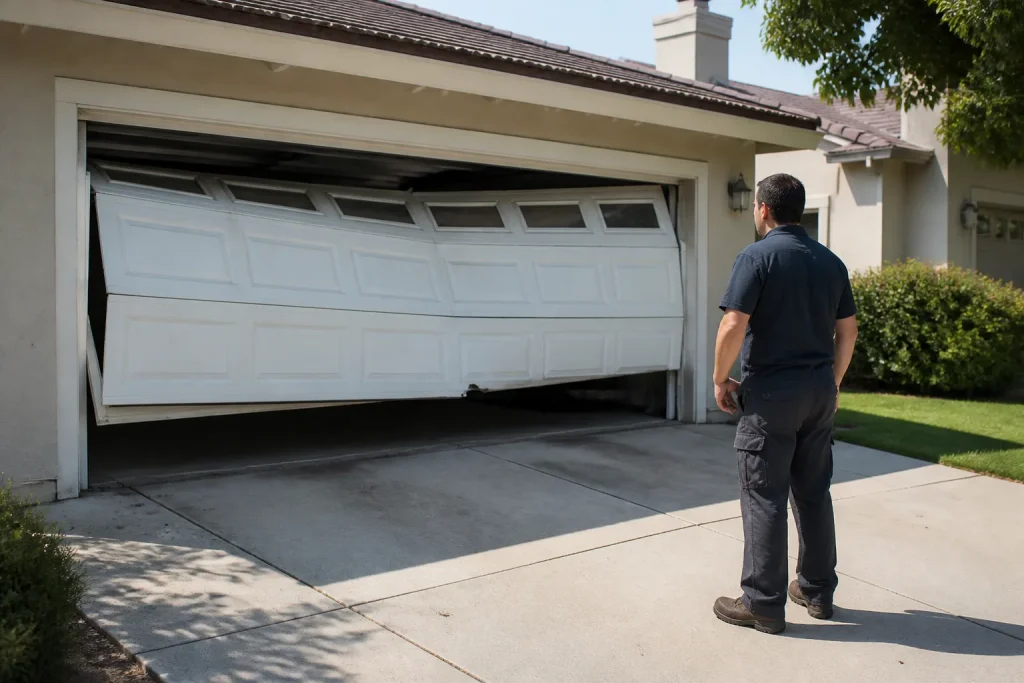
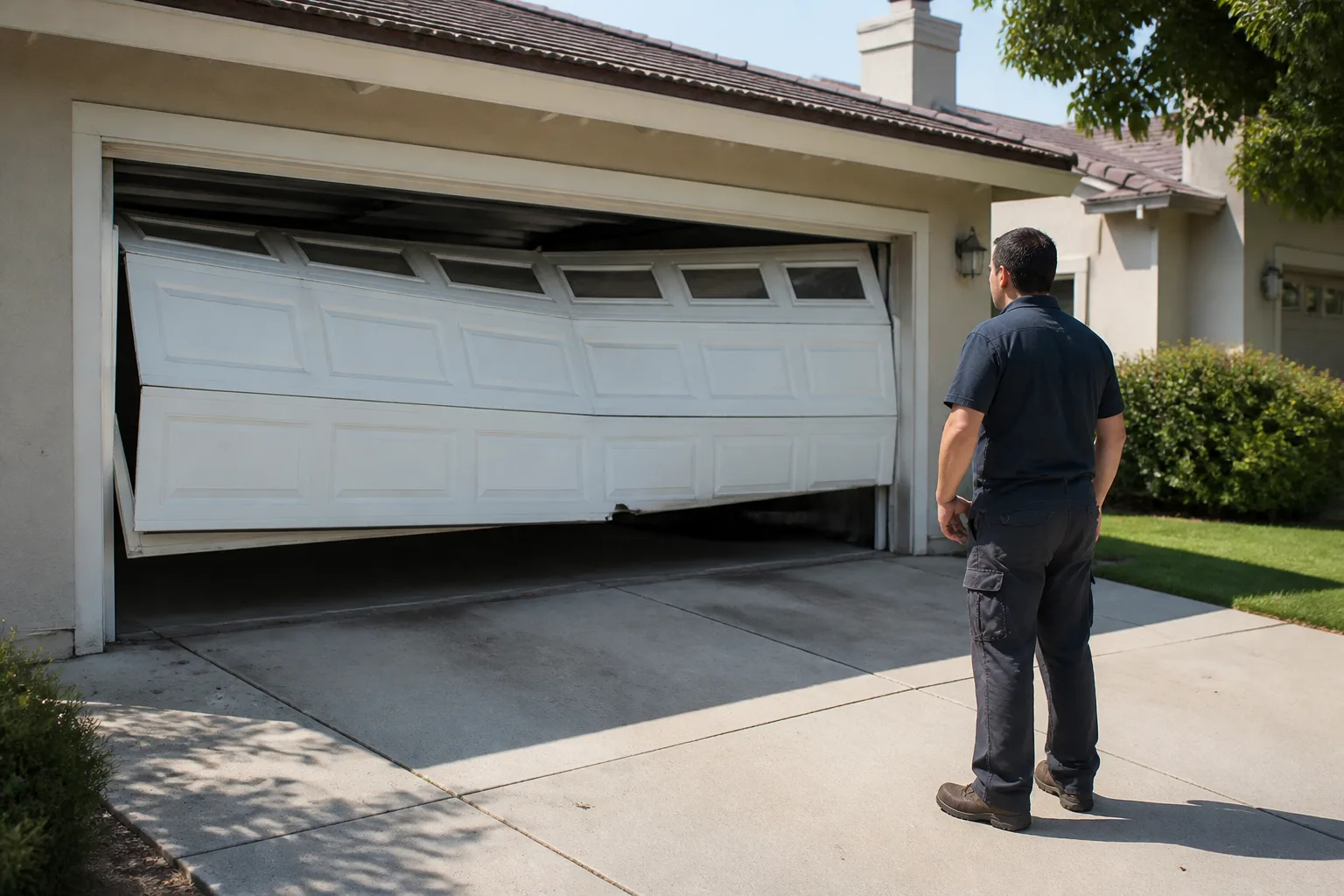
- Door is crooked or hanging at an angle: Snapped cable or a wheel off the track. Also leave it alone. A cable under residual tension can whip when it lets go.
- Door closed fine but won’t open, opener makes noise: Likely the opener or a stripped gear. You can often pull the release cord safely here if you follow Step 3 below.
- Door is visibly bent, dented, or off its rollers: Something hit it or a roller seized. Don’t force it.
Every one of these has a different repair path, and the price difference between a spring replacement and a full track realignment in Los Angeles can be several hundred dollars. Knowing what you’re looking at before you call means no bait-and-switch when a tech arrives and “finds” additional damage you couldn’t verify.
Step 2: Decide If You Should Even Be Standing There
Some garage door failures are safe to work around. Others are genuinely dangerous. A torsion spring holds hundreds of pounds of tension, and when it snaps, the stored energy releases in a fraction of a second. If you’re underneath it when that happens, the result can be serious. Same goes for cables, which are under constant tension even when the door is down.
Here’s our simple rule for Los Angeles homeowners: if the failure involves the spring or the cables, stay out of the garage and close the interior door. That’s the “wait inside” situation. If the failure is the opener itself and the door is fully closed, you have more room to work. The opener isn’t holding the door up; the springs and cables are. Disengaging a dead opener with healthy springs is a low-risk move, provided you do it correctly.
The split matters because we’ve seen too many homeowners in neighborhoods like Echo Park and Silver Lake, where garages sit under living space, treat a snapped spring like a minor inconvenience and start poking at the release cord. A spring failure isn’t a convenience problem. It’s a mechanical system holding the weight of a 150-to-400-pound door. Treat it like the energy system it is.
Step 3: The Right Way to Disengage the Emergency Release Cord (And the One Mistake That Causes Extra Damage)
The emergency release cord is the red handle hanging from your opener rail. Pulling it disconnects the door from the opener carriage so you can lift the door by hand. It exists so you can get your car out during a power outage. But pulling it at the wrong time, or from the wrong position, can add real cost to your repair.
The critical rule: only disengage when the door is fully closed. Pulling the release cord while the door is even partially open, especially if a spring has snapped, means the full weight of the door is now unsupported. A door released mid-travel with a broken spring will drop, and a dropped door bends panels, shatters rollers, and pulls cables off their drums. That’s the most common avoidable damage we see on emergency calls across Los Angeles.
If the door is fully closed and the springs look intact, the release is safe to pull. It will disconnect with a firm tug, and you can then lift the door manually. Expect it to be heavy. If it won’t move, or if it feels like it’s catching on something, let it back down gently and call us. Forcing a door that’s fighting you is how tracks get twisted.
One more thing: after you disengage, don’t leave the door in manual mode with the opener still plugged in and active. If someone presses the remote, the carriage will travel without the door, which is loud and confusing but rarely damaging. Just unplug the opener or tape over the wall button until the repair is done.
Step 4: What to Photograph and Measure Before You Call Anyone
Before you pick up the phone, take 90 seconds to gather the things that let us give you an accurate quote over the phone instead of a vague “we’ll see when we get there.” This is the difference between a reputable Los Angeles garage door company and a dispatch mill that banks on you not knowing anything about your own door.
Photograph these five things:
- The spring above the door. Is there a visible gap in the coil? That tells us whether it’s a standard torsion spring, a pair of springs, or an extension spring setup on an older door.
- The cable on both sides. Is one frayed, loose, or off the drum? Get as close as you safely can without standing under the door.
- The door from inside, closed. A straight-on shot shows misalignment, bent tracks, or a door sitting unevenly.
- The brand name. It’s usually on the panel edge or the opener. If your opener says Chamberlain, Genie, or another major brand, that helps the tech arrive knowing what they’re walking into.
- The track and rollers on both sides. Even if nothing looks wrong, a photo gives us a baseline.
Measure the door’s height and width, and if you can, check the spring’s wire thickness with a cheap caliper or just feel it with a finger against a quarter for comparison. Even knowing the door is “a 16×7, single spring” helps us tell you whether you’re likely looking at $150 or $400 before we dispatch anyone. That’s not a sales gimmick. On a spring repair or garage door cable repair in Los Angeles, the parts are standard and the labor is predictable. We quote it, write it down, and lock it before anyone gets in a truck.
Step 5: How to Tell If a “24/7 Emergency” Company Is Actually Local
Here’s a sentence every Los Angeles homeowner has either heard or suspected: the “24/7 emergency garage door repair” company you called isn’t local at all. It’s a national call center that routes your job to whichever independent tech in your zip code will pay the highest fee for the lead. You don’t find that out until the tech shows up, looks at the door, and quotes a number that has nothing to do with the phone estimate.
You can usually root this out before you hang up. Ask the person on the phone these four questions:
- “Are you physically located in Los Angeles, or is this a dispatch service?” Listen for hesitation.
- “Who is the technician coming to my house, and what company do they work for?” A real company can tell you.
- “Does the tech carry a written price sheet, and will I see the number before work starts?” If the answer is “it depends on the job,” you’re talking to a lead broker.
- “What’s the name of the owner or the local manager?” If they can’t name anyone, it’s a call center.
We answer all of those questions on every emergency call. The tech who shows up is background-checked, uniformed, and trained on eight leading brands: LiftMaster, Chamberlain, Genie, Clopay, Amarr, Wayne Dalton, Craftsman, and Raynor. You’ll see their name and photo before they arrive, and you’ll have a live arrival time you can track on your phone. That’s the Relay Visibility Guarantee, and it applies to every job we run, emergency or not.
Related services in Los Angeles: if your spring snapped, see Garage Door Spring Repair in Los Angeles. If the opener is dead and you need a full door assessment, start with Garage Door Repair in Los Angeles. And if you’re not sure what you’re looking at, Marlow Garage Door Repair can diagnose it over the phone.
What LA’s Hillside Homes and Older Stucco Garages Get Wrong
Los Angeles isn’t one flat grid, and your garage door doesn’t fail the same way in Mount Washington as it does in Sherman Oaks. Hillside homes, particularly older stucco construction from the 1940s through the 1970s, often have garages built into the slope with off-grade slabs and shifting foundations. That movement puts uneven load on the door, which means springs fatigue unevenly and cables wear on one side faster than the other.
We see this pattern constantly. A homeowner in Silver Lake calls because a spring snapped, and when we arrive, the real story is a door that’s been settling for a decade, bearing more weight on the left track than the right. The spring was the symptom. Flat-lot homes in the Valley have a different short list: heat-affected opener logic boards, sun-damaged weatherstripping that lets heat in and warps panels, and track alignment that drifts over years of daily use.
The point isn’t that one type of home is worse. It’s that a competent tech should know the difference before they pull up. If you call a generic national dispatch line, the person who shows up may not know anything about Los Angeles construction patterns. If you call us, the person on the phone has seen this block of houses before, and the tech carrying the tools knows what they’re walking into. That local repetition is why we can quote a spring replacement over the phone with confidence while a call center reads you a script.
When to Call a Pro
If you’ve read this far and you’re looking at a door with a broken spring, a snapped cable, or a track that’s visibly bent, call a pro. Those are not DIY repairs, regardless of what a YouTube video tells you. The spring stores enough energy to break bones. The cable under tension can cut. The track under load can buckle and drop the door.
Here’s when you can absolutely call us: any spring failure, any cable failure, any door off its track, any door that banged and won’t move, and any opener that’s dead and you’d rather not diagnose. We’ll answer the phone with a real person, get your photos, and give you a written price before we dispatch. That price won’t change when the tech arrives, unless you ask for additional work and approve a new written quote first. That’s how we’ve operated, and it’s backed by the Done Right Promise: if the repair isn’t right, we come back and make it right, free, for a full year.
The Bottom Line
Your door slams down at 7 AM. You’re late. Your instinct is to panic, pull the red cord, and start calling the first number that shows up under “emergency garage door repair near me.” That instinct is expensive. Slow down for ten minutes. Check the spring. Check the cables. Photograph everything. Only pull the release cord if the door is fully closed and the springs are intact. Then call a company that will quote you a real number before anyone gets in a truck.
If you’re in Los Angeles and that’s the experience you want, we’re here 24/7. Marlow Garage Door Repair answers every call with a real person, sends a background-checked tech with a live arrival time, and puts the written price in your hand before any work starts. Call (512) 883-4374 for a free estimate, or book online and see your tech on the way. You’ll know exactly what you’re paying before the first wrench turns.
Frequently Asked Questions
An emergency spring replacement in Los Angeles typically runs $150 – $290 depending on spring type and door size, while a snapped cable will usually be in the $120 – $220 range. More involved jobs, like a door off its track or a bent panel, can run higher. At Marlow Garage Door Repair, you’ll get a written price before any work starts, so the number you agree to is the number you pay. Call (512) 883-4374 for an exact quote on your door.
Yes. We run emergency garage door repair calls across Los Angeles every day, including same-day dispatch for spring and cable failures. When you call, you’ll talk to a real person who can schedule a tech and give you a live arrival window you can track on your phone. Call (512) 883-4374 and we’ll tell you honestly when we can get there.
Only if the door is fully closed and the springs above the door look intact. Pulling the release cord while the door is partially open, especially with a snapped spring, lets the full weight of the door drop, which causes significant damage. If you’re not sure, leave the cord alone and call us first. We’ll talk you through the check on the phone.
Do not try to lift the door manually. A snapped spring means the door’s full weight is unsupported, and lifting it risks dropping the door, bending the track, and causing injury. Call us right away at (512) 883-4374. We’ll get a Los Angeles tech to you with the right spring on hand, and you’ll have a written price before the repair begins.
We’re trained on eight major brands: LiftMaster, Chamberlain, Genie, Clopay, Amarr, Wayne Dalton, Craftsman, and Raynor. If your opener or door is one of those, the tech arriving at your Los Angeles home already knows the specific system. If you have something else, call us and we’ll tell you straight whether we can help before we send anyone out.
Written by the team at Marlow Garage Door Repair.
Need Garage Door Help?
Call Marlow Garage Door Repair - licensed & insured, here with fast after-hours help in Los Angeles.
(512) 883-4374