
5 Mistakes to Avoid With Garage Door Repair
The five most expensive garage door repair mistakes aren’t rookie errors. They’re completely reasonable-sounding decisions that backfire because the garage door industry has specific quirks most homeowners never learn. A $12 can of the wrong lubricant can destroy a $90 set of rollers in three months. A “quick YouTube fix” can send you to urgent care. If you’d rather skip the guesswork, call (512) 883-4374 for a free estimate and a written price before any work starts.
We’ve been fixing garage doors in Los Angeles, and every mistake on this list is something we’ve watched cost a homeowner real money. None of them required bad intentions. They required information nobody handed out. Here it is.
Mistake #1: Replacing a Torsion Spring Yourself
Watching a YouTube video to replace your own torsion spring isn’t brave. It’s the leading cause of serious hand and wrist injuries in residential DIY repair. The torsion spring, that horizontal coil above your door, holds enough tension to lift a 150-pound door hundreds of times a day. When it snaps or gets mishandled, that tension releases in a fraction of a second.
What makes this categorically different from replacing a faucet or patching drywall is the stored energy. A torsion spring under tension is a loaded weapon. The winding bars most tutorials tell you to use can slip. The cone, the metal fitting at the end of the spring, can break. A fractured forearm, severed tendon, or crushed fingers are all documented outcomes. This isn’t about skill. It’s about the fact that even experienced technicians treat spring work with serious caution.
And here’s the part nobody mentions: even if you avoid injury, getting the tension wrong means your door will lurch hard, fall fast, or chew up its opener. A spring that’s over-wound by even half a turn changes how the whole system behaves. In Los Angeles, we see this constantly in older homes in Silver Lake and the Valley where doors have settled over decades and the original spring specs no longer match reality.
What to do instead: call a pro. Spring replacement typically runs $150 to $290 depending on spring type, and you’ll see the exact number before we start. No surprises, no hospital copays. If you’re in Los Angeles and need garage door spring repair, the written price is locked before any wrench turns.
Mistake #2: Replacing Only One Spring When Both Are the Same Age
A lot of homeowners hear “one spring snapped” and reasonably think they need one spring. Here’s the math: torsion springs have a lifecycle rated in cycles, not years. A standard 10,000-cycle spring on a door that opens four times a day lasts roughly seven years. If one spring fails at seven years, its partner is at the same age, the same cycle count, and the same fatigue point.
Replacing only the broken spring means the old one snaps within weeks. We’ve watched it happen over and over. You pay a service call fee to replace one spring, and then four to six weeks later, the second spring fails and you pay that service call fee again. You’ve now doubled your labor cost to save roughly $80 on a spring.
This is even more relevant in Los Angeles, where garages are often used as storage units, workshops, or workout spaces. Doors open and close far more than four times a day in a lot of these homes. A spring that’s rated for 10,000 cycles can hit that limit in three years or less.
The honest recommendation: when one spring goes, replace both. You’ll pay more on that single visit, but less than you’d pay over the two visits you’re otherwise guaranteed to make. And any decent technician will tell you this before you ask. Ours do.
Mistake #3: Accepting a Verbal Quote
You call a company. The guy on the phone says “spring jobs usually run about two to three hundred.” You hear a price. Legally, you’ve heard an estimate, which means nothing. What you don’t have is a quote, which is a legally binding number.
The specific language technicians use that sounds like a price but isn’t: “should be around,” “typically runs,” “probably won’t exceed,” “in that ballpark.” None of those words commit the company to a number. When the invoice comes back $180 higher because the tech “found additional issues,” you have no recourse. You agreed to labor and materials at whatever the final number turned out to be.
There’s a three-word response that converts a verbal estimate into a written commitment: “Put it in writing.” Say it before the tech starts working. If the company hesitates, resists, or says they’ll “write it up at the end,” you’re talking to the wrong company.
We put the price in writing before any work begins, on every job, no exceptions. That’s not a policy we add for certain customers. It’s the standard. The number on your invoice matches the number you agreed to. If that’s not how it works, the verbal estimate is a fishing hook.
Mistake #4: Lubricating the Wrong Parts
WD-40 is a solvent, not a lubricant. It strips the existing grease off metal and leaves behind a thin film that evaporates within days. Spray it on your nylon rollers, and the roller’s internal bearings run dry. Spray it on nylon and it accelerates wear. Within a few months, a $90 set of nylon rollers gets chewed up, the door runs rough, and the opener motor starts working harder to compensate.
This is one of the most common things we correct in Los Angeles garages. Someone follows a blog post from 2011, sprays WD-40 across everything under the door, and then wonders why it’s noisier six months later.
What actually gets lubricated, and with what:
- Rollers (steel bearings only, never nylon or plastic): white lithium grease or a dedicated garage door roller lubricant, one drop per bearing.
- Hinges: white lithium grease at the pivot points, the spots where metal moves against metal.
- Springs: a silicone-based lubricant sprayed lightly along the coil length.
- The opener rail for screw-drive openers: garage door opener grease, sparingly.
If your rollers are nylon, lubrication should be minimal and focused on the metal hinge points, not the wheel itself. If you’re not sure what type you have, snap a photo and ask a pro before you spray anything. The wrong product on the wrong part turns a silent door into a grinding one.
Mistake #5: Hiring Based on Response Speed Alone During a Panic
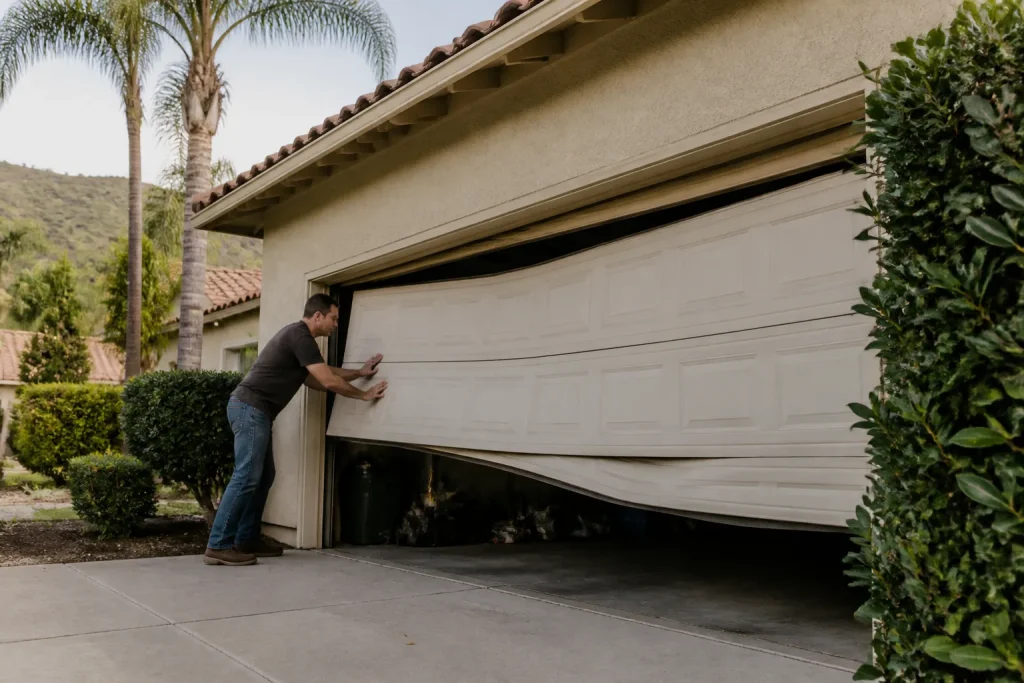
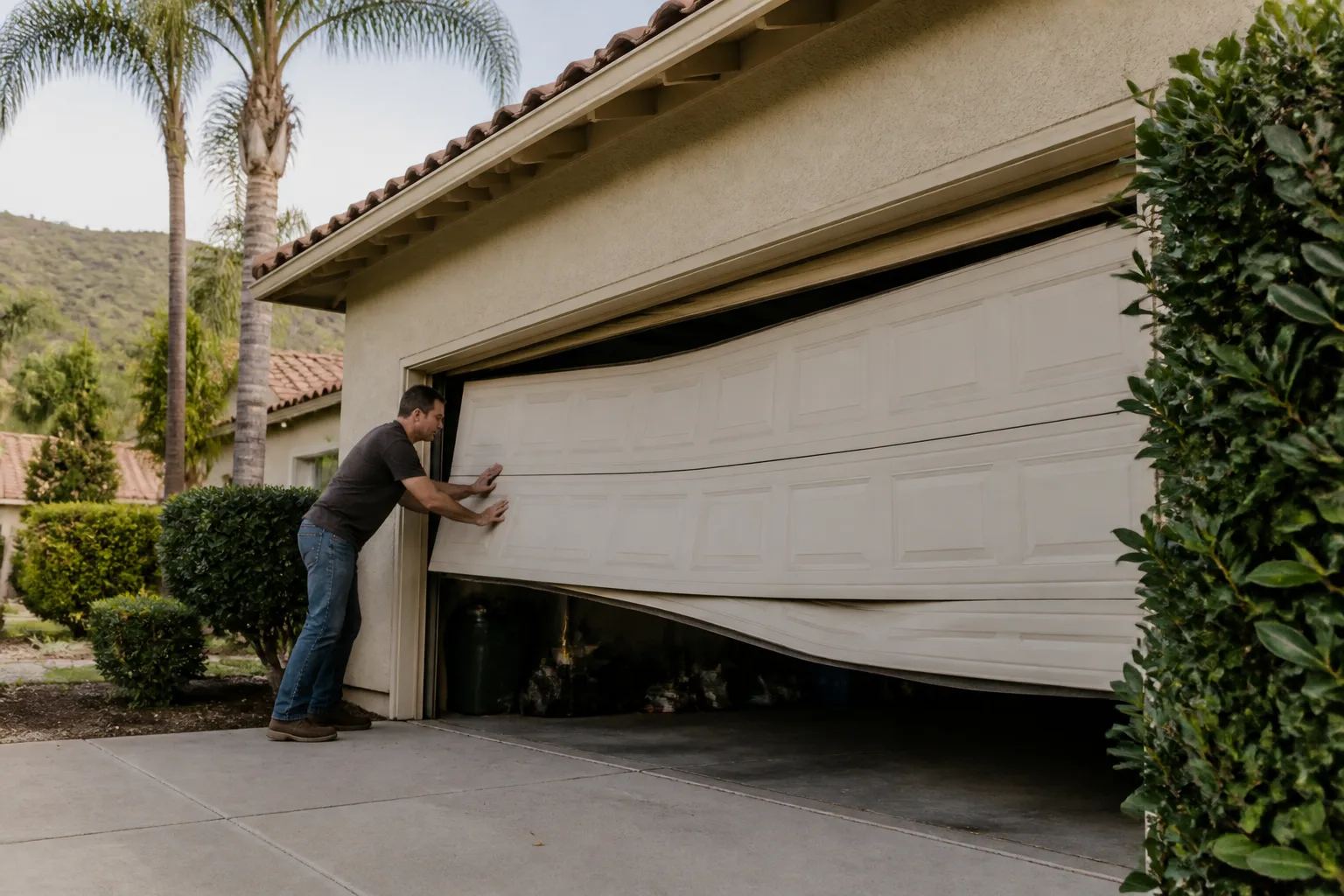
Your door is stuck half open at 7:40 p.m. Your car is inside. You need someone now. So you call the first company that answers and says they can be there in 20 minutes. That’s how people end up paying $700 for a $180 repair.
Here’s the reality: a garage door that’s stuck open is a hassle, but it’s rarely an emergency. The door isn’t going to fall. The mechanism that holds it in place may be damaged, but gravity isn’t about to yank a section out of the track. You have time to make one good phone call.
The five-minute due diligence check that prevents a bad hire under pressure:
- Ask for a written price range before the tech leaves the shop? If they won’t give one, they’re planning to price at the door.
- Ask who is coming: name, photo, background check status. A company that won’t tell you who’s walking up your driveway has something to hide.
- Ask about the warranty: specifically, what happens if the repair fails in six months. A one-year written guarantee is the standard you want to hear.
- Ask if they service your brand. If your opener is a LiftMaster, Chamberlain, Genie, Clopay, Amarr, Wayne Dalton, Craftsman, or Raynor, the tech should already know how it’s built. A company that “works on everything” with no specific brand training is improvising.
We pulled a spring out of a garage in Atwater Village last month where the previous company had installed one that was two sizes too small, charged a premium for the “emergency response,” and never gave the homeowner a written quote. The spring failed in six weeks. The homeowner paid twice, once for nothing. A five-minute phone call would have caught it.
If you’re in Los Angeles and need garage door repair, the phone is answered by a live person 24/7. You’ll get a written price, a live arrival window you can track, and a tech who is background-checked and uniformed before they ever reach your driveway.
How We Handle These Mistakes Every Day at Marlow
We don’t just point at other people’s failures. We built the business to remove the decisions that lead to them.
Every repair we do comes with the Done Right Promise. That’s a written guarantee, not a spoken one. If the repair isn’t right, we come back and make it right. Free. For a full year. No pro-rating, no “wear and tear” exclusions.
We also give you the written price before any work begins. Not after the tech has taken the door apart. Not after the old parts are in the truck. Before. The invoice matches the quote, every time. We were founded, and this has been the standard since day one. We’re part of the Relay Home Co. family of independently owned, local home-service businesses, and we’re held to The Relay Visibility Guarantee on every service call: a live arrival time you can track, before-and-after photos, a written price, and a digital invoice you pay from a link.
If you’d rather not DIY and you want someone who will tell you the truth about what needs replacing and what doesn’t, call (512) 883-4374. You’ll get a free estimate, a real person on the phone, and zero pressure to buy anything you don’t need.
Related services in Los Angeles: garage door spring repair and garage door cable repair. Both come with the same written-price guarantee and the same Done Right Promise.
The Bottom Line
Garage door repair mistakes are expensive because they compound. Buy the wrong lubricant and you’re replacing rollers in three months. Accept a verbal quote and you’re negotiating after the work is done. Replace one spring and you’re paying a second service call in weeks. Every one of these mistakes is avoidable with a simple rule: notice the specific detail.
- Springs: always both, always professionally installed.
- Quotes: always written, always before work starts.
- Lubrication: right product, right part, not WD-40 on nylon.
- Hiring under pressure: five good questions before you say yes.
- Warranty: one year, in writing, from a company that can actually honor it.
If you’re in Los Angeles and need help, Marlow Garage Door Repair offers free estimates. Call (512) 883-4374 and get a written price before any work begins. We’ve been doing this, and we’d rather you call us before the WD-40 than after.
Frequently Asked Questions
No. Torsion springs hold enormous stored tension and release it explosively when mishandled. The risk of serious hand, wrist, and facial injury is real even for experienced DIYers. This is the one garage door repair where the cost of hiring a pro is always justified.
In Los Angeles, spring replacement typically runs $150 to $290 depending on spring type and door size. The exact number should be quoted in writing before any work begins. If a company won’t give you a written price, you’re not getting a quote.
Yes. Springs wear on a cycle count, meaning both springs in a paired system are at the same fatigue point. Replacing only the broken one means the second spring will fail within weeks, and you’ll pay a second service call. Replace both and save the double visit.
Yes. We keep live phone support available 24/7, and we’ll give you a written price and a live arrival window before a background-checked tech heads your way. Call (512) 883-4374 for exact availability and a free estimate.
Written by the team at Marlow Garage Door Repair.
Need Garage Door Help?
Call Marlow Garage Door Repair - licensed & insured, here with fast after-hours help in Los Angeles.
(512) 883-4374