
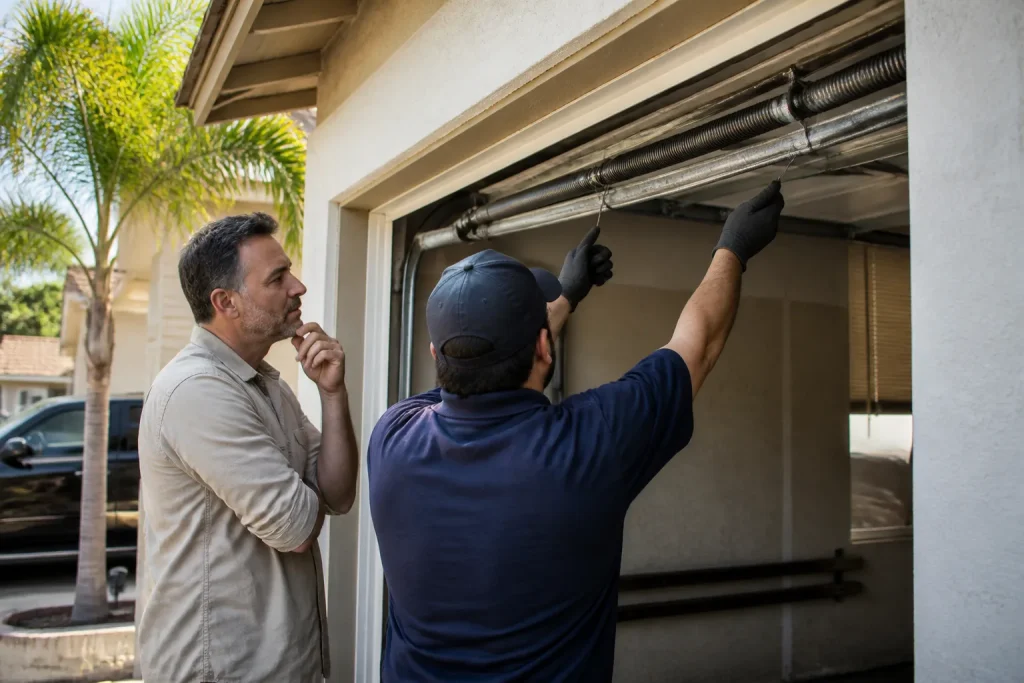
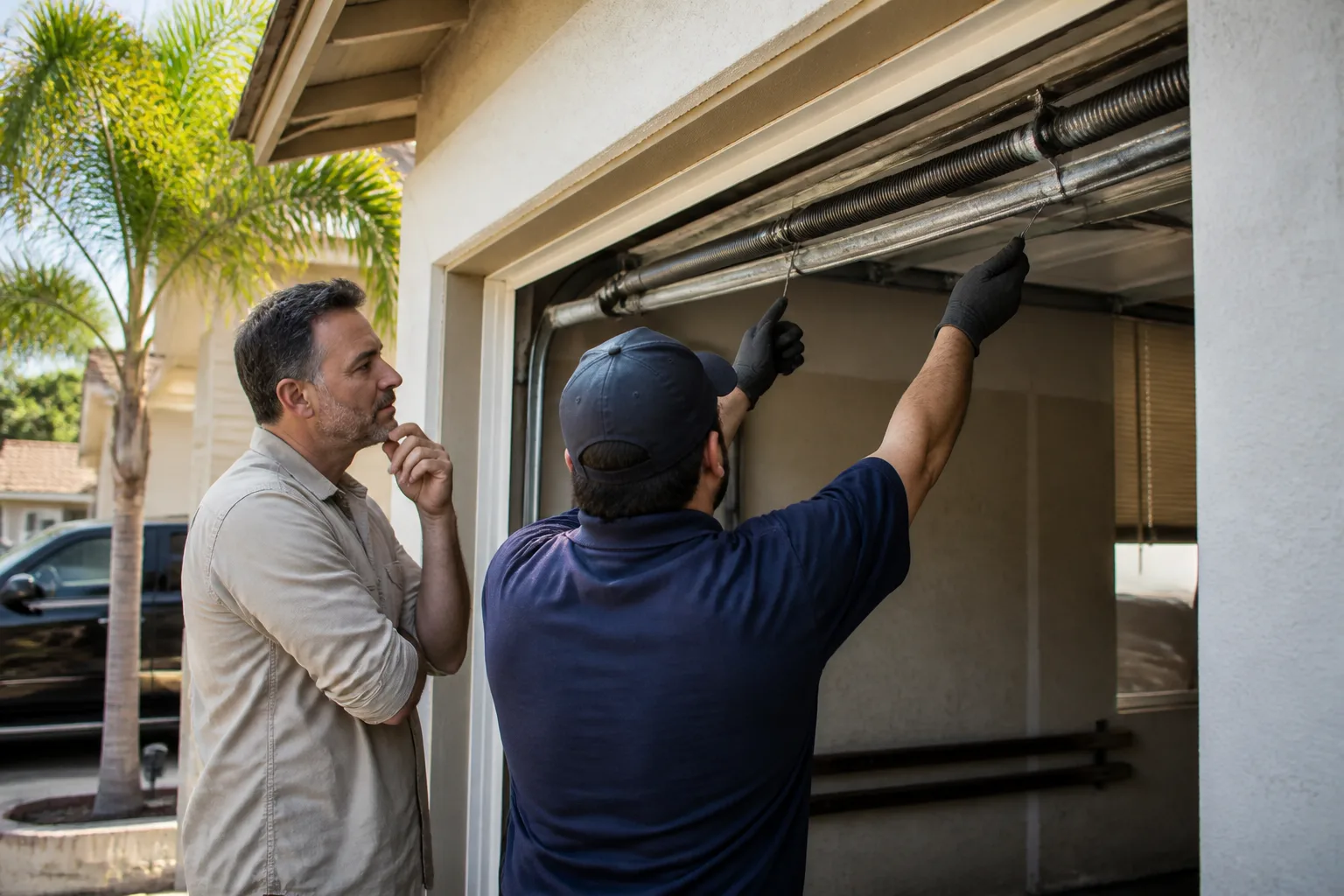
Garage Door Spring Repair: Repair or Replace? How Los Angeles Homeowners Decide
Here’s the thing: you can’t actually repair a garage door spring. Torsion springs and extension springs are wear components, like brake pads. When one snaps, it’s done. The real question Los Angeles homeowners should be asking is whether to replace one spring or both, and whether to upgrade the cycle life rating while the door is already apart. If you’d rather skip the research and just get a written price, call (512) 883-4374.
- Springs are replaced, never repaired – any technician offering to “repair” a broken spring is either new or using sloppy language.
- Paired replacement usually makes financial sense – the second spring is at the same cycle count and typically fails within weeks.
- High-cycle springs cost roughly $40 – $70 more per spring in LA and can triple the lifespan.
- Most LA homes built after 1990 use torsion spring systems – safer, smoother, longer-lasting than extension springs.
Why “Repair” Is the Wrong Word – and Why That Matters
When a garage door technician says they can “repair” your spring, that’s a red flag. A broken torsion spring – the horizontal coil above your door that does most of the lifting – has snapped metal running through its core. You can’t weld it, splice it, or patch it. Anyone who tells you otherwise is either dishonest or under-trained. The correct terminology is spring replacement, and an experienced tech will say exactly that.
In Los Angeles, where thousands of garage door companies compete for the same neighborhoods, this language distinction is actually a useful filter. At Marlow Garage Door Repair home, we train our technicians to explain what a torsion spring is before assuming you know, and to use precise language throughout the estimate. If a company’s first contact uses vague terms like “spring service” or “spring fix,” ask them directly: “Are you replacing the spring or repairing it?” The answer tells you everything.
Replace One or Replace Both? The Math Los Angeles Homeowners Should See
Here’s the scenario we see weekly in neighborhoods from Sherman Oaks to Eagle Rock: a homeowner has two torsion springs above the door. One snaps. They get a quote to replace just the broken one. The price looks lower, so they go with it. Then the second spring – same age, same cycle count, same wear – fails four to six weeks later. Now they’re paying for a second service call, a second labor charge, and another afternoon of waiting around.
The cycle count is the key number. Standard springs are rated for roughly 10,000 open-and-close cycles. If your Los Angeles home’s door has been in use for 8 to 10 years, both springs are at or near that limit. When spring A breaks at cycle 9,800, spring B is at cycle 9,800 too. The cost comparison looks like this:
- Replace one spring now: $150 – $290 for the spring and labor. Second spring fails within weeks: another $150 – $290 plus a second trip fee if the company charges one.
- Replace both springs now: $280 – $480 in most Los Angeles markets. One service call, one labor charge, zero surprise failures this year.
Mathematically, replacing both is almost always the cheaper option within a 90-day window. The only exception is if the other spring was replaced recently – within the last 18 to 24 months – in which case replacing just the broken one is genuinely reasonable. Ask for the install date of the unbroken spring before you decide.
Torsion vs. Extension Springs: What’s Actually in Your LA Garage
Los Angeles homes built after 1990 overwhelmingly use torsion spring systems. These sit on a metal shaft above the door opening, and they wind and unwind to lift the door. They’re safer because they’re contained on the shaft, they operate more smoothly, and they tend to last longer – typically 10,000 to 15,000 cycles depending on the spring quality.
Extension springs are the older style: two springs that stretch along the horizontal tracks on either side of the door. They’re common in LA homes built before 1990 and in many rental properties. They’re cheaper to install but fail more dramatically – when an extension spring snaps, it can send metal flying across the garage if the safety cable isn’t in place. That safety cable is not optional. If you have extension springs and no safety cable running through them, that’s a needed upgrade regardless of whether the spring itself is broken.
Can you retrofit from extension to torsion in a Los Angeles home? Yes. It typically costs $400 – $800 depending on the door width and existing hardware. For most homeowners, the retrofit is worth it if the door is heavy (wood or double-wide) or if the garage opens into a living space where noise matters. For a standard single-car aluminum door that’s rarely used, extension springs with a safety cable are serviceable. When you call us at Marlow, we’ll tell you which system you have and whether a retrofit pencils out – no pressure either way.
Cycle Life Ratings: The Upgrade Most LA Homeowners Miss
Every garage door spring has a cycle life rating, which is the number of open-and-close cycles it’s engineered to survive before the metal fatigues and snaps. Standard springs are rated for 10,000 cycles. High-cycle springs are rated for 25,000 cycles or more. The price difference in Los Angeles is typically $40 – $70 per spring.
Here’s the practical math for a house in, say, Westchester or Highland Park. If you open your garage door four times a day (leave in the morning, come home, run an errand, park for the night), a standard spring lasts about 6.8 years. A high-cycle spring lasts 17 years. That extra $40 – $70 per spring buys you more than a decade of not thinking about garage door springs at all.
The upgrade pays for itself if:
- You plan to stay in the Los Angeles home for more than two more years.
- Your garage door is your primary entrance (common in LA where driveways are short and street parking is scarce).
- You have a heavy door – solid wood, double-wide, or carriage-style from brands like Clopay or Amarr puts more stress on springs.
- You use the garage for storage and the door goes up and down multiple times daily.
We quote both options on every spring replacement in Los Angeles. The written price you get from Garage Door Spring Repair in Los Angeles includes both the standard and high-cycle numbers so you can decide with real figures, not abstract “well, it’s an upgrade” language.
The One Scenario Where Replacing a Single Spring Is Correct
There is exactly one situation where we’ll tell a Los Angeles homeowner to replace just the broken spring and skip the paired work: when the other spring was replaced recently and you can verify it.
We pulled a spring out of a garage in Atwater Village last month where the homeowner had receipts from another company showing the left spring was replaced 11 months prior. The right spring – the original from 2013 – snapped. In that case, replacing just the failed spring made perfect sense. The newer spring still had roughly 9,500 cycles of life left in it. Replacing both would have wasted a good spring.
So how do you confirm your situation qualifies?
- Find the receipt, invoice, or work order from the previous spring replacement.
- Check the date. If it’s within the last 18 – 24 months, you likely have a justified single-spring replacement.
- Look for a spring color code or tag on the unbroken spring – some installers mark the install date.
- Ask the technician to physically inspect the unbroken spring for wear. A trained eye can spot corrosion, stretched coils, or stress marks that signal imminent failure.
If you can’t confirm the unbroken spring’s age, replace both. That’s the advice we give our own families, and it’s the advice we give every customer from Chamberlain and Genie-heavy garage setups to the classic Wayne Dalton doors you still see all over the San Fernando Valley. For broader door issues beyond springs, our Garage Door Repair in Los Angeles page covers the full range of what we see.
When to Call a Professional – Straight Talk
Torsion springs are under hundreds of pounds of tension. When one snaps while you’re standing next to it, the release of that stored energy can throw metal across the garage with enough force to break bone. This isn’t a “be careful” situation – it’s a “this can genuinely injure you” situation. In our 20-plus years serving Los Angeles, Jaylen has seen the aftermath of DIY spring attempts that ended in emergency-room visits. Never attempt to wind, unwind, or remove a torsion spring yourself, and never remove the center bracket on a spring shaft.
What you can safely check from the ground:
- Look at the spring above your door. If you see a gap in the coil, it’s broken.
- If the door opens a few inches and stalls, or slams shut when you release it, the spring has failed and your opener is now fighting the full door weight alone.
- Listen for a loud bang from the garage followed by a door that won’t open – that’s the spring snapping.
Any of those signs in a Los Angeles home warrants a pro. Spring replacement is a same-day job in most cases, and the price should be in writing before the first wrench turns. If you’re seeing a broken cable instead of a broken spring – the thin metal line along the side of the door – head over to Garage Door Cable Repair in Los Angeles.
The Bottom Line
The repair-or-replace question has a short answer: springs get replaced, not repaired. The longer decision is one-versus-two and standard-versus-high-cycle. In most Los Angeles homes, replacing both springs at once is the financially smarter move, and upgrading to high-cycle springs is a $40 – $70 per spring insurance policy that keeps you from doing this again for over a decade.
If you’re in Los Angeles and you’ve got a broken spring, a door that won’t open, or just a suspicion that something overhead isn’t right, Marlow Garage Door Repair offers free estimates. We’ll send you a written price before any work starts, and every spring we replace is backed by our Done Right Promise – if it fails within a year, we come back and make it right at no charge. Call (512) 883-4374 or book online and you’ll see your technician’s live arrival window before they pull up.
Frequently Asked Questions
No. Garage door springs are not repairable. Once a torsion or extension spring snaps, it must be replaced. Any technician who offers to “repair” a spring is using incorrect terminology – ask them to clarify whether they mean replacement, and if they insist a spring can be patched or welded, get a second opinion.
Spring replacement in Los Angeles typically runs $150 – $290 for a single spring including labor, or $280 – $480 for a pair. High-cycle springs add $40 – $70 per spring. Marlow Garage Door Repair gives you a written price before any work begins, so the number on your invoice matches the number you agreed to. Call (512) 883-4374 for an exact quote.
Replace both unless you can prove the unbroken spring was installed within the last 18 – 24 months. Garage door springs wear at the same rate, so if one just snapped at roughly 10,000 cycles, the other is at the same threshold and will likely fail within weeks. Replacing both costs less than two separate service calls.
Standard 10,000-cycle springs last about 7 years with average use in LA – around 4 open-close cycles per day. High-cycle 25,000-cycle springs last roughly 17 years under the same conditions. If you use your garage as a primary entrance or have a heavy door, the upgrade usually pays for itself within the first replacement cycle.
Written by the team at Marlow Garage Door Repair.
Need Garage Door Help?
Call Marlow Garage Door Repair - licensed & insured, here with fast after-hours help in Los Angeles.
(512) 883-4374