
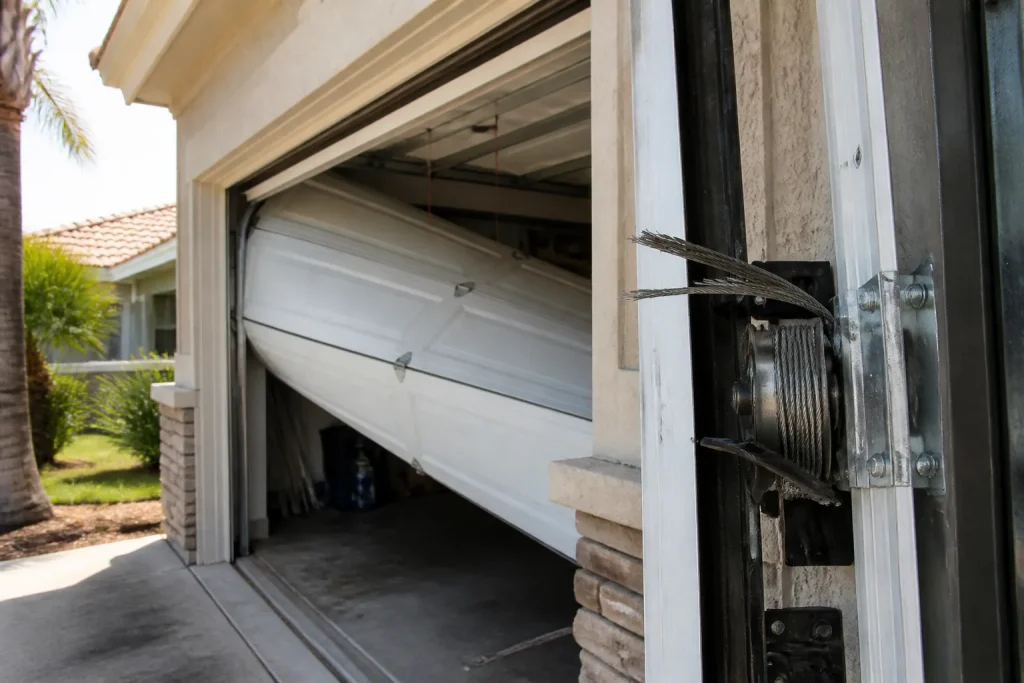
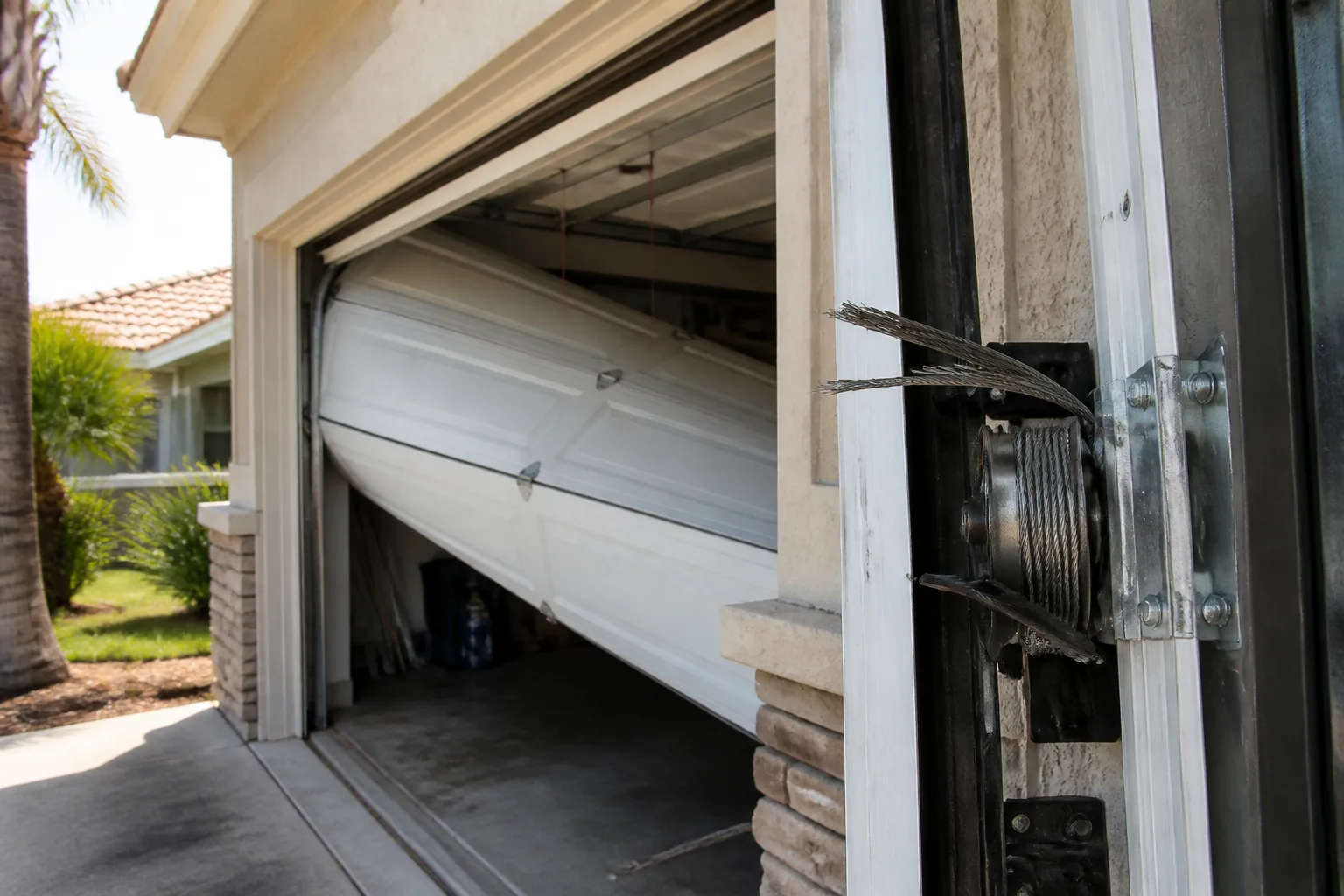
5 Mistakes to Avoid With Garage Door Cable Repair
Garage door cables snap under thousands of pounds of tension, which is why the repair mistakes that cost homeowners the most are the ones made before the technician ever sets foot in the garage. Approving a cable replacement without checking the drum, skipping a spring re-tension, shopping price without comparing cable gauge, treating the snap as isolated, and not getting the balance result in writing account for most repeat failures we see across Los Angeles. If you’d rather skip the research and have someone handle it right the first time, call Marlow Garage Door Repair at (512) 883-4374 for a free estimate.
Here’s the thing about garage door cables that most people learn the expensive way: the cable itself is rarely the root cause. It’s the part that fails, sure. But it fails because something else in the system changed. A spring settled, a drum wore down, a bracket bent. When you only replace the cable and leave the underlying problem in place, the new cable becomes a ticking clock. You’re not fixing anything. You’re financing the next failure. Los Angeles garages are full of doors where this exact sequence has played out two or three times, each visit billed as a separate repair because the previous tech never asked the uncomfortable question: why did this cable actually break?
Mistake #1: Approving a Cable Job Without Confirming Drum Condition
The drums on a garage door are the grooved wheels mounted above the door on the torsion tube, one on each side. The cables wind and unwind around these grooves every time the door moves. When a drum is worn, its grooves get shallow or rough, which causes the cable to rub, bind, and fray at predictable points along its length.
Here’s what we’ve learned in two decades of replacing cables in Los Angeles: worn drums re-fray new cables within months, sometimes weeks. The cable fails again, and the homeowner assumes the first repair was botched, when in reality the first tech simply never looked at the drum.
In our experience, a technician should visibly inspect both drums on every cable repair and tell you what they found, in plain words. If a drum is worn, it gets replaced at the same time as the cable. That’s not an upsell. It’s the difference between a repair that lasts one month and one that lasts years. We worked on a Clopay door in Sherman Oaks last spring where the homeowner had gone through two cable replacements in eight months. Both previous techs quoted only the cable. We pulled the drum and found grooves so shallow the cable was riding up out of them under tension. New drum, new cable, problem gone.
Ask the question directly when you call: “Are you checking the drum condition as part of this job?” If the answer is vague, get a second opinion.
Mistake #2: Not Asking Whether the Tech Will Reset Spring Tension
Cables and springs work as a balanced pair. The torsion spring above your door stores the energy that lifts the weight. The cables transfer that energy. When a cable breaks, the door’s balance is thrown off, which means the spring tension is almost never where it should be by the time a tech arrives.
Skipping a spring re-tension after a cable replacement leaves you with a door that’s heavier on one side, or too heavy overall. You’ll notice it in the opener motor laboring to lift what used to feel effortless, and in the uneven wear that starts showing up on rollers, hinges, and the new cable itself. The most common symptom we see in Los Angeles garages: a door that drifts down a foot or two after being opened halfway, then stops. That’s a balance problem.
A proper cable repair includes resetting the tension on both sides of the spring system so the door sits balanced when you lift it manually. This takes a trained hand, because the spring on a typical two-car garage door can hold enough torque to break a wrist if it releases while you’re working on it. We train our techs to check balance as part of every cable job, not as an add-on. For a Wayne Dalton door, which often has a different spring configuration than stock hardware, that reset is even more critical.
When you’re getting quotes, ask: “Does your cable replacement include re-tensioning the springs so the door is balanced when you leave?” If the tech looks confused by the question, call someone else.
Mistake #3: Using Price as the Only Filter
Cable gauge and material grade vary wildly between quotes at similar price points. A low quote might be a thinner 1/8-inch cable where a 5/32-inch cable is standard, or a shorter length that barely reaches the drum with proper wraps. The difference in raw material cost is a few dollars. The difference in the life of the cable can be years.
Here’s a field observation: in Los Angeles, where coastal air in places like Venice and Marina del Rey accelerates corrosion on exposed metal, cable grade matters more than it does inland. A galvanized cable at the correct gauge will outlast a thinner uncoated one exposed to salt air. You can’t evaluate that by price alone.
What you can do is ask what size and type of cable is being installed. Aircraft-grade galvanized steel at 5/32-inch diameter is the spec we use for most residential doors. A company should be able to tell you this. If the answer is “the good stuff,” keep shopping.
This is where the written price matters too. A mechanic doesn’t quote you a brake job and then bill you for a second brake job because the parts changed. A garage door quote should work the same way. The number you agree to is the number you pay. We’ve made that a hard rule at Marlow because paying more than the agreed price is the second most common fear we hear from callers, right after the door failing again. We work on Raynor doors regularly, and their cable systems are well built, but even a Raynor fails when the cable’s the wrong size.
Mistake #4: Treating a Cable Repair as Isolated
The event that snapped the cable is usually still present when the tech arrives. Sometimes it’s a broken spring that transferred all the tension to one cable. Sometimes it’s a bent bottom bracket that changes the angle the cable pulls at. Sometimes it’s a door that’s been running unbalanced for months after a minor bumper hit.
In our experience across Los Angeles, roughly a third of cable failures we see have a spring issue hiding behind them. The cable snaps because the spring broke first, or because the spring is so tired it’s no longer doing its half of the lifting. The cable snaps because the door is heavier than it used to be and something had to give.
The mistake is letting a tech replace the cable and walk away without checking the spring, the brackets, the rollers, the track alignment, and the opener’s force settings. A good cable repair is really a system check with the cable replacement attached to it, not the other way around. That’s why our techs are trained to diagnose the whole door when a cable fails, and why we service LiftMaster, Chamberlain, Genie, Clopay, Amarr, Wayne Dalton, Craftsman, and Raynor. Your specific door’s hardware determines what typically fails alongside the cable.
Mistake #5: Not Getting the Post-Repair Balance Result in Writing
After any cable repair, the technician should manually lift the door to confirm it sits balanced and holds position. That test takes sixty seconds. It’s the single most direct indicator that the repair was done correctly. And yet almost nobody gets that result documented.
Ask for it. Specifically: “Can you note the balance test result on the invoice or the service record?” If the tech is confident in their work, they’ll do it without hesitation. The point isn’t to catch them in a lie. The point is that documentation creates accountability. Six months later, if the door is sagging again, you want a written record of what was checked and what was found at the time of the repair. It protects you under warranties, and it gives the next tech a real data point instead of a guess.
We do this on every job as part of our Done Right Promise. The promise isn’t just marketing language. It means if the repair isn’t right within a year, we come back and make it right at no charge. That promise is written, not spoken, and it’s one of the reasons people in Los Angeles call us for cable work on their garage door cable repair in Los Angeles.
Key Takeaways
– Confirming drum condition is non-negotiable on any cable repair. Worn drums eat new cables.
– Spring re-tensioning should be part of every cable job, not an optional add-on.
– Compare cable gauge and material, not just price. The wrong gauge fails early.
– A cable snap is a symptom. Diagnose the whole door, especially springs and brackets.
– Get the balance test result in writing. It’s your warranty shield.
The Bottom Line
Garage door cable repair isn’t complicated, but it is unforgiving of shortcuts. The five mistakes above share a common thread: each one is a decision point where the homeowner gives up control without realizing it. You don’t need to become a garage door technician to avoid them. You need to ask the right questions and get the answers in writing.
If you’re in Los Angeles and you’d rather hand this to someone who does it right, Marlow Garage Door Repair home is one call away. We’ll give you a written price before any wrench turns, and every cable repair is backed by our Done Right Promise. If you’re also having spring trouble, we handle garage door spring repair in Los Angeles as well. Call (512) 883-4374 for a free estimate, or book online and track your tech’s arrival in real time. You’ll know who’s coming, what it’ll cost, and that the job will be done right for a full year.
Frequently Asked Questions
How much does garage door cable repair cost in Los Angeles?
Cable replacement in Los Angeles typically runs $150 to $290 depending on cable type, drum condition, and whether a spring re-tension is included. Our pricing is always a written quote before work starts, so the number you agree to is the number on the invoice. Call (512) 883-4374 for an exact number for your door.
Can a broken cable be fixed the same day?
Yes, cable replacement is a same-visit repair for most common doors. Our techs carry cable stock and drums on hand, and they’ll tell you the price before starting. The only exception is when a special-order cable is needed for an unusual configuration.
Is it dangerous to replace a garage door cable myself?
Yes. Garage door cables and the torsion springs they work with are under enough tension to cause serious injury. We don’t recommend attempting cable replacement without proper training and tools. The risk isn’t worth the few hundred dollars saved.
Does the Done Right Promise cover cable repairs?
Yes, every cable repair performed is covered for a full year under the Done Right Promise. If the repair isn’t right within that year, we return and make it right at no charge. The guarantee is stated in writing on your invoice.
Written by the team at Marlow Garage Door Repair.
Need Garage Door Help?
Call Marlow Garage Door Repair - licensed & insured, here with fast after-hours help in Los Angeles.
(512) 883-4374