
Preparing Your Home’s Garage Door for Winter in Los Angeles
Preparing your garage door for winter in Los Angeles means swapping petroleum-based lubricant for silicone before nighttime temperatures settle into the 40s, checking weatherstripping compression along the bottom and sides, and re-tensioning cables that have worked loose over summer. It’s a 20-minute job that prevents the single most common winter failure we see: a door that refuses to open on the first cold morning of the year. If you’d rather not spend your Saturday on a ladder, call (512) 883-4374 and we’ll handle the whole checklist for you.
Most winter-prep articles for garage doors are written for Minneapolis or Chicago, where the concern is ice dams and frozen track wheels. Los Angeles gets 35 nights a year below 50°F. That’s not cold enough to freeze anything solid, but it is exactly the temperature range where standard garage door grease thickens to the consistency of cold peanut butter. Add a little moisture from our rainy season and a loose cable from last spring, and you’ve got a door that works fine in October and quits in January. Here’s what to do before that happens.
Why 40 to 55 Degrees Is the Danger Zone for LA Garage Doors
The garage door system you have in Los Angeles relies on small, precise movements: rollers gliding in tracks, a torsion spring unwinding smoothly, cables staying taut on both sides of the drum. All of that depends on lubrication staying at the right viscosity. Standard white lithium grease, which is the default in most hardware stores, starts getting noticeably thicker around 50°F. Below 45, it’s thick enough that the opener motor has to work harder to move the door. That extra strain is what finally kills a spring that’s been marginal for months.
In our experience across Los Angeles neighborhoods from Woodland Hills to Highland Park, the failure pattern is consistent. The door opens a little slower than usual in late November. Nobody thinks much of it. Then one morning in January, the opener runs but the door doesn’t move, or the door opens six inches and stops. We get that call three or four times a week between December and February. The fix is usually straightforward: clean the old grease off the track and rollers, then re-lubricate with a silicone-based product. Silicone doesn’t thicken in cold weather the way lithium grease does, and it doesn’t attract dust the way petroleum products do. For Los Angeles conditions, silicone is the right tool every time.
If you do one thing this month, make it this: wipe down the tracks and rollers with a dry rag, then apply a thin coat of silicone lubricant to the rollers, hinges, and the torsion spring above the door. Skip the tracks themselves; lubricated tracks just collect LA dust and gum up faster.
LA’s Real Winter Threat Is Water, Not Cold
The idea that winters in Los Angeles are mild misses what actually happens between November and March. We get roughly 80 percent of our annual rainfall in those five months. That water has to go somewhere, and the bottom edge of your garage door is where it tries hardest to get in. A worn rubber weatherstrip along the bottom of the door lets rainwater seep under and pool on the garage floor. Over a season, that moisture finds its way into the bottom panel, into the track brackets, and eventually into the spring assembly, where it accelerates rust.
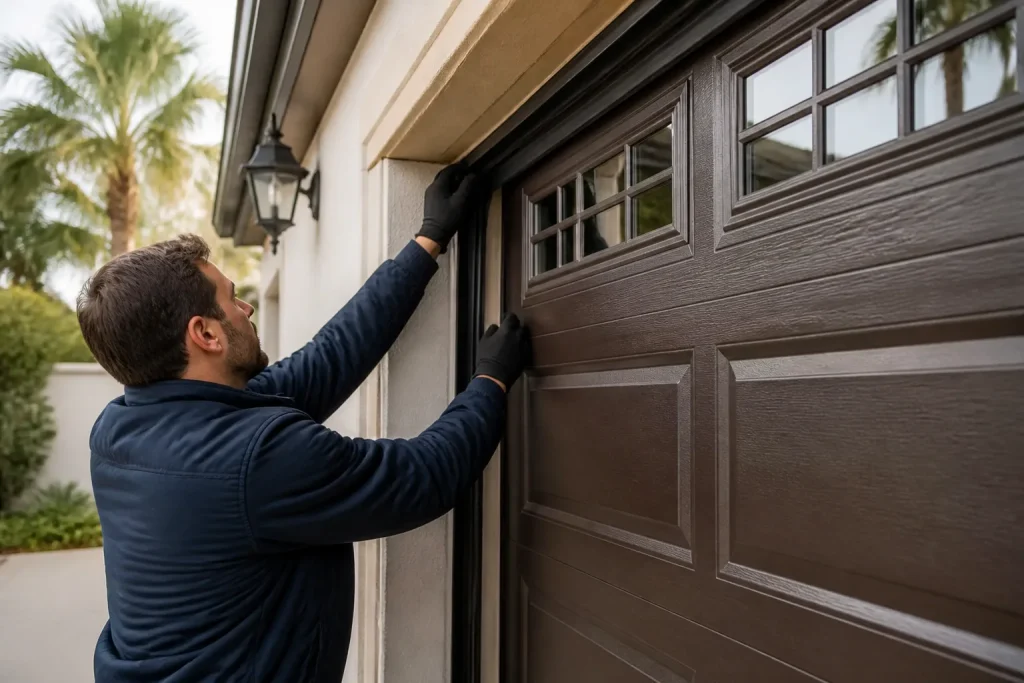
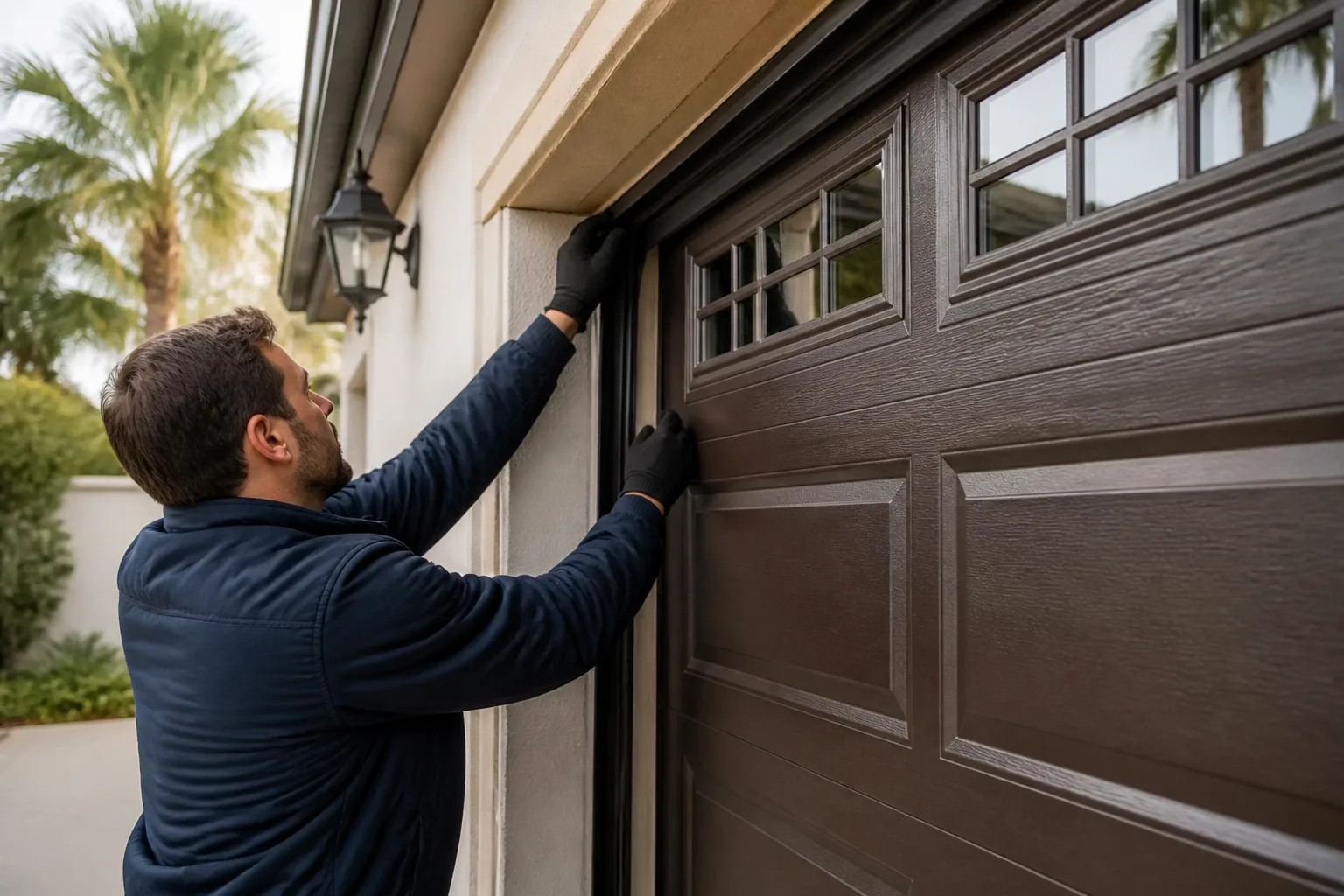
Check the bottom weatherstrip by closing the door and looking for daylight passing under the edge. If you can see light, water gets through too. Replacement weatherstripping is inexpensive and typically installs in under 30 minutes with basic hand tools. While you’re down there, look at the side weatherstripping too, especially where it’s stapled or nailed into the door frame. Los Angeles sun degrades rubber fast, and hairline cracks in the side seals let wind-driven rain in during the heavier storms. The fix is a new strip and a tube of exterior-grade sealant around the mounting points.
One more water spot that gets overlooked: the top of the door where it meets the header. If your garage is on an older home in an LA neighborhood like Eagle Rock or West Adams, that top gap may have shifted as the house settled. A taller top seal, or simply re-hanging the door with corrected tracks, closes that gap and keeps rain out of the garage interior.
Three Things to Test Before the El Niño Rains Arrive
El Niño years push warmer Pacific water toward the California coast, which for Los Angeles means more frequent and heavier rain events between December and March. Forecasters have been watching this winter for exactly that pattern. Before the first big storm hits, test these three components. Each takes less than ten minutes, and all three are common winter failure points.
1. Weatherstripping compression. Close the door and run your hand along the bottom seal, then the side seals. The rubber should be compressed firmly but not flattened. If it feels spongy or if you can press it flat with a finger, the seal has lost its elasticity. It’s no longer keeping water out. Replace it before the rain, not after the first flooded garage floor.
2. Cable tension. Look at the cables on both sides of the door, which run from the bottom brackets up to the drums at the top. Both sides should be equally taut, with no visible slack and no fraying at the connection points. A cable that’s slightly loose on one side means the door is lifting unevenly, which puts additional stress on the springs and opener. In Los Angeles, we see uneven cable tension most often on doors that face due west, where years of sun and heat have caused the door itself to warp slightly. If your door doesn’t close evenly, those cables need attention.
3. Photo-eye alignment. The two small sensors, one on each side of the door near the floor, have to point directly at each other for the door to close. In LA, these get bumped by bicycles, trash bins, lawn equipment, and occasionally a teenager’s skateboard. If the green light on one sensor is blinking or off, bend the bracket gently back into alignment until both lights are steady. A door that refuses to close in winter is often just a photo-eye that’s stopped seeing its partner.
Why Santa Ana Winds Beat Temperature as the Bigger Threat
Drop the temperature 20 degrees and your garage door barely notices. Hit it with a 45-mile-per-hour Santa Ana gust, though, and you’re testing the structural limits of every track bracket, hinge, and panel. Southern California’s fall and winter are Santa Ana season, and those winds can rattle an uninsulated garage door like a sail in a storm. That repeated flexing is what loosens track brackets and starts the process that eventually throws a door off its rollers.
Every garage door has a wind-load rating, which tells you how much lateral pressure it’s designed to resist without deforming. For most of Los Angeles, a standard residential door rated for 90 to 100 mph wind loads is fine. But if you live in a canyon community like Topanga, Laurel Canyon, or anything along the foothills where the Santa Anas channel through, you want a door rated higher, ideally with horizontal steel struts bolted across each panel to add rigidity. Brands like Clopay and Amarr make wind-rated doors specifically for this purpose, and they’re worth considering when it’s time to replace rather than just repair.
When we install doors in wind-prone parts of Los Angeles, we recommend one simple, often-overlooked upgrade: a heavier-duty track bracket. Most standard doors use 14-gauge track. In wind corridors, going to 12-gauge steel along with deeper fasteners into the door frame makes the difference between a door that holds its alignment through storm season and one that needs adjustment every spring. It’s the kind of thing that never gets mentioned in generic winter-prep articles because it doesn’t show up on a checklist. But it’s real, and it matters.
If your door rattles in the wind, that’s not normal. It means something is loose, misaligned, or underbuilt for where you live. Rattling that goes ignored through one Santa Ana season turns into a door that jumps its track in the next one.
The 20-Minute Pre-Winter Inspection, Built for Los Angeles
Forget the Midwest advice about antifreeze and heat tape. Here’s the checklist we’d give a friend in Los Angeles, calibrated for our actual conditions: no hard freezes, plenty of rain, sun damage on everything that faces south, and winds that test every fastener. Set aside 20 minutes on a Saturday morning and go through these seven checks.
- Watch the door open and close fully, twice. Listen for grinding, shuddering, or any hitch in the motion. A door that hesitates halfway up is testing your springs, and springs don’t recover on their own.
- Check the balance. Pull the red release handle while the door is closed, then manually lift the door about waist height. Let go. It should stay put. If it drops, your springs are losing tension. If it shoots up, they’re too tight. Either way, the opener is doing work it isn’t meant to do.
- Inspect the bottom and side weatherstripping for cracks, flattening, or daylight showing through. This matters more for an LA winter than it does for a Chicago one.
- Look at the cables on both sides. Frayed wires or visible slack is a repair, not a maintenance item. A snapped cable leaves a door hanging by one side, and nobody wants that on a rainy Tuesday at 7 a.m.
- Wipe down the tracks and rollers, then apply silicone lubricant. Avoid WD-40, which is a solvent that strips lubricant rather than adding it, and skip anything petroleum-based for reasons we covered earlier.
- Test the photo-eye sensors by closing the door and passing a foot through the beam. The door should reverse immediately. If it doesn’t, that’s a safety issue, not a maintenance one.
- Tighten every bracket bolt and hinge screw you can reach. The vibration of daily use, plus the occasional Santa Ana rattle, loosens fasteners over the course of a year. Ten minutes with a socket wrench now saves real money later.
That’s the whole list. It requires no special tools, no experience, and no ladder if you can reach the spring and track bolts from a step stool. If any step reveals a problem you’d rather not solve yourself, that’s exactly what we do every day at Garage Door Repair in Los Angeles. We’ve seen every failure this checklist is designed to catch, and we’d rather catch them in October than February.
When to Call a Pro Instead of Going the DIY Route
Most of what’s on this checklist is safe for anyone with a step stool and a basic tool set. But there are three areas where doing it yourself is genuinely dangerous, and we’ll say it plainly rather than let you find out the hard way. Torsion springs, the horizontal coils mounted above the door, are under enormous tension. That spring is what makes the door feel light when you lift it, and when it breaks or needs adjustment, that stored energy releases instantly. A wound spring can cause serious injury if it lets go while you’re working on it. We also recommend against touching the bottom cable brackets, which carry similar tension, and anything involving the full weight of the door off its tracks. These are jobs for someone with the training and the right tools.
For everything else, the winter-prep work is straightforward. If you’d like a second set of eyes or just don’t have the time, we’re happy to do the full inspection and the minor fixes in one visit. We’re trained on eight major brands, including Chamberlain, Genie, and Wayne Dalton, so whichever opener or door you have, we know exactly what it needs before we arrive.
There’s one more Los Angeles-specific service worth mentioning while we’re here. If your door has been running fine but the cables look old, or if you live in a wind-prone area and the door has seen a few hard Santa Ana seasons, our Garage Door Cable Repair in Los Angeles service catches cable problems before they leave you stranded. And if the balance test above showed a dropping door, that’s almost certainly a spring issue. You can read more about what that looks like and what it costs at our Garage Door Spring Repair in Los Angeles page.
The Bottom Line
Winter preparation for a Los Angeles garage door has nothing to do with freezing and everything to do with the specific combination of cool nights, rainy season, and Santa Ana wind events that define our cold months. Swap to silicone lubricant. Replace weatherstripping that’s cracked or flattened. Check the balance, the cables, and the photo-eyes. Tighten the fasteners. Twenty minutes, once a year, and you’ll skip the most common winter failures we see at Marlow Garage Door Repair home.
If you’re in Los Angeles and want help with any of this, Marlow Garage Door Repair offers free estimates, a written price before any work starts, and a 365-Day Done Right Promise on every repair. We also send you a live arrival time so you don’t spend a day waiting around. Call (512) 883-4374 and we’ll walk you through it.
Frequently Asked Questions
Yes. Los Angeles winters don’t bring freezing temperatures, but they do bring 40 to 55-degree nights that thicken standard lubricants, a rainy season that tests weatherstripping, and Santa Ana winds that loosen track brackets and strain panels. A quick pre-winter check catches these problems before they cause a failure.
Use a silicone-based lubricant, not petroleum-based grease or white lithium grease. Silicone stays thin in the 40 to 55-degree range where lithium grease gets thick and sluggish, and it doesn’t collect the dust that’s a constant in Los Angeles. Apply it to rollers, hinges, and the torsion spring, and wipe the tracks dry.
Doing it yourself costs about $15 to $30, which covers a can of silicone lubricant and replacement weatherstripping if needed. Having it done professionally, including a full inspection and minor adjustments, typically runs $75 to $150 depending on the door’s condition. Companies like Marlow quote a written price before any work starts, so you know the number upfront. Call (512) 883-4374 for an exact quote, and know the estimate is free.
This is the classic Los Angeles winter pattern. Cold temperatures thicken whatever lubricant is on the rollers and tracks, which makes the opener work harder. If your springs are already weak or a cable is slightly loose, that extra strain is enough to stop the door entirely. The door doesn’t break on a cold morning; it breaks on the morning the cold makes an existing problem too much to overcome.
Written by Jaylen Ross, Owner at Marlow Garage Door Repair, serving Los Angeles since 2002.
Need Garage Door Help?
Call Marlow Garage Door Repair - licensed & insured, here with fast after-hours help in Los Angeles.
(512) 883-4374