
Top Signs You Need Garage Door Service – Don’t Ignore These
A garage door that takes two seconds longer to open than it used to isn’t aging gracefully – it’s burning out your opener motor. In Los Angeles, where doors cycle anywhere from 1,500 to 3,000 times a year depending on whether you park on the street or in a garage, that extra strain adds up fast. Most homeowners call us only after something breaks. The door always told them first. Here’s how to hear it in time, and what waiting actually costs. If you’d rather skip the detective work, call (512) 883-4374 and we’ll walk you through it.
Key Takeaways
- The quiet, slow-building warning signs cost the most when ignored – a $95 fix now becomes a $600 cable replacement in six months.
- You can catch spring tension problems in 90 seconds with two simple tests we explain below.
- Where you live in Los Angeles changes how fast these problems escalate. We’ll cover that too.
- Not every noise is the same problem. Grinding, popping, and squealing mean three totally different things.
The Warning Signs Most People Ignore – and What They Actually Cost
We’re going to be blunt: the dramatic failures get the attention. The snapped spring. The door that fell in the driveway. The cable that frayed and whipped across the track. Those are the endings. But every one of those endings had a beginning, and the beginning usually looked like nothing. A two-second pause. A faint grind. A door that sits maybe an inch lower on one side than it used to. In our experience, the homeowners who catch it early pay a fraction of what the emergency call costs. Here’s the math nobody puts on a website.
The cost-of-waiting breakdown below is based on what we’ve actually seen across Los Angeles service calls. Not a national average. Not a guess. LA doors see everything from Santa Monica salt air to San Fernando Valley heat, and the spread matters.
Symptom: The Door Is Slower Than It Used to Be
When your opener motor has to push harder to move the door, it doesn’t complain loudly. It just gets slower. Maybe two seconds. Maybe four. What’s actually happening is that your springs – the torsion springs above the door that do the real lifting – are losing tension. The opener motor was only ever designed to move a balanced door. When the springs start to weaken, the motor takes up the slack. And motors aren’t built for that. They overheat, the gears inside the opener head strip, and you’re replacing the whole unit.
What it costs now: A spring tension adjustment typically runs $95 to $150 in Los Angeles. That’s a diagnostic visit plus the adjustment itself.
In 30 days: Springs have lost enough tension that the door starts creaking and the motor sounds strained. You’re now looking at spring replacement – typically $150 to $290 depending on spring type – plus whatever wear the opener has taken.
In 90 days: The spring snaps while the door is halfway up. If you’re lucky, the safety cable contained it. If not, you’re replacing a bent track, a burned-out opener, and possibly the spring itself. That’s a $400 to $800 repair that started as a $95 adjustment. We pulled a door out of a garage over in Valley Village last month where exactly this happened. The homeowner told us the door had been “a little sluggish” since spring. It cost them $640. The spring cost $190.
Two Tests You Can Do in 90 Seconds
We teach every homeowner we meet how to do these two tests, because they’ll catch spring problems before they become spring failures. Neither test requires any tools and neither puts you in contact with tensioned parts. Important safety note up front: torsion springs are under extreme tension and should never be adjusted, removed, or even poked at by anyone who isn’t trained on them. What we’re describing here is diagnosis, not repair.
The Bounce Test
Open your door halfway – about waist height. Now let go. A properly balanced door should stay put, maybe drifting an inch in either direction. If the door slides down on its own, your springs are losing tension. If it shoots up, the springs are over-tensioned. Either way, the opener motor is compensating for something it shouldn’t have to. That’s the two-second-per-cycle strain we’re talking about.
The Force Resistance Test
Close the door, then detach the opener using the red emergency release cord hanging from the track. Now try lifting the door by hand. It should move with moderate, steady effort – maybe 10 to 20 pounds of feel. If it feels like you’re lifting a refrigerator, the springs aren’t doing their job. If it feels almost weightless, the springs are doing too much, and the door can slam shut if a cable fails. Either finding means it’s time to have a professional look at it. In Los Angeles, we recommend running these tests seasonally – especially after a Santa Ana stretch, when the dry heat and dust can accelerate spring fatigue.
Symptom: The Door Opens Fine but Closes Unevenly
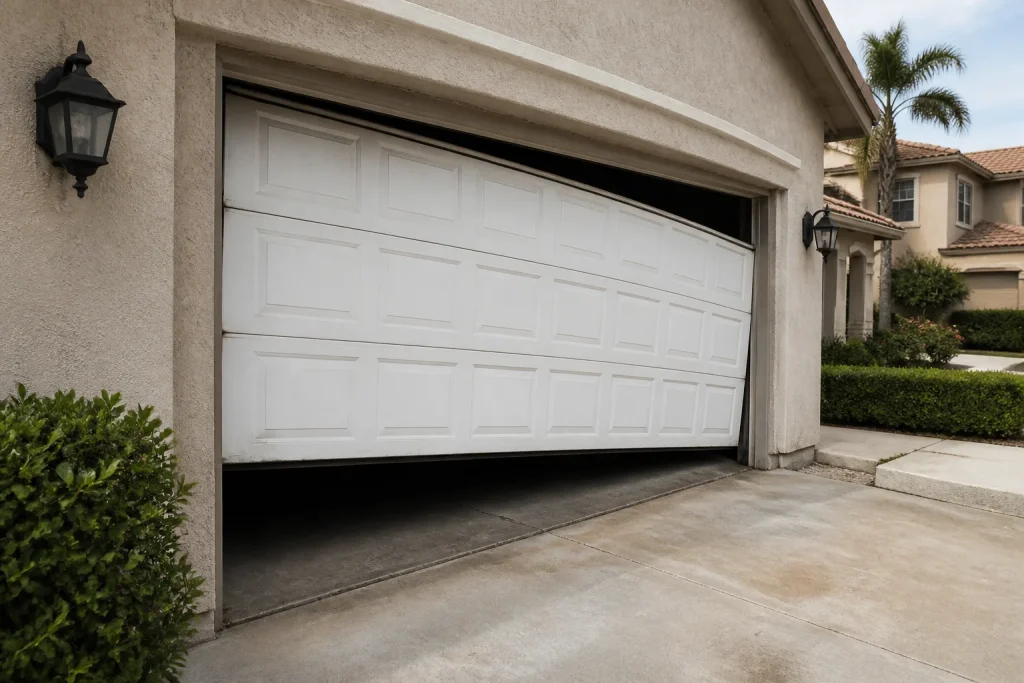
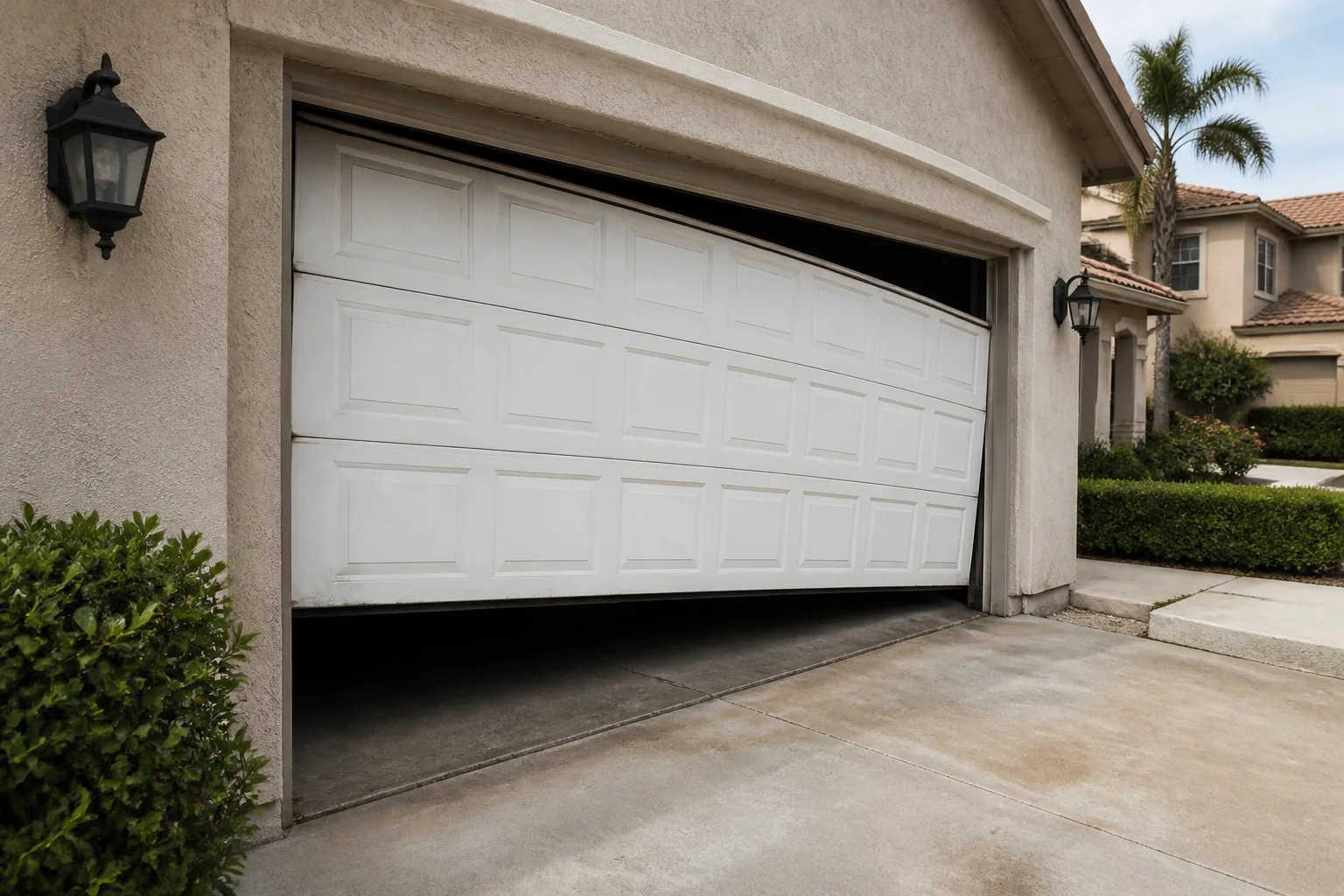
This is the one we’d flag as more urgent than slow movement, and here’s why. A door that moves slowly is a spring problem developing slowly. A door that closes unevenly – dips on one side, leaves a gap at the bottom, scrapes one track – is often a cable problem developing right now. The cables on each side of your door work as a pair. When one side’s cable stretches or frays, that side of the door drops lower. Every cycle puts more load on the remaining cable. That cable eventually lets go, and when it does, the door drops fast.
We’ve seen this happen in Sherman Oaks, in Echo Park, in Long Beach. It’s not a geography thing. It’s a “the door still opens so I can still park inside” thing. And it’s the exact scenario where a homeowner waits because nothing is technically “broken.” But an uneven close means something structural is already failing. The repair differential is real: straightening a door that’s slightly out of square might cost $120 to $180 if caught early. Replacing a snapped cable and re-hanging the door because it torqued in the tracks? That’s $300 to $450, and it often happens on a Friday evening.
If your door closes with a scrape, a pause, or a visible tilt on one side, don’t wait for the door to tell you louder. Call (512) 883-4374. We’ll tell you over the phone whether it sounds like a track alignment or a cable issue, and what the realistic price range is for your area of Los Angeles.
Sound Diagnosis: What Your Garage Door Is Actually Saying
Garage doors make noise. That’s fine. But the kind of noise is a diagnostic goldmine, and most people lump every noise into “my garage door is loud.” Here’s the breakdown of what each specific sound means, based on what we hear on calls across Los Angeles every single week.
Grinding Noise
A grinding noise – like rocks in a metal can – almost always means worn rollers. The wheels that ride inside your door’s track are supposed to roll. When the bearings inside the roller wear out, the wheel stops rolling and starts sliding. Metal-on-metal. That grinding is your rollers being ground flat, and it’s also shaving metal off your tracks. Roller replacement in LA typically runs $100 to $180 for a full set, and it’s a quick fix. Ignore it and the tracks themselves get gouged – now you’re replacing track sections at $150 to $250 each.
Popping Noise
A popping sound, especially when the door is opening, is often a torsion spring winding or unwinding not-smoothly. Springs don’t fail silently. They announce themselves. If you hear popping, the spring is telling you it’s developing micro-fractures. A spring that snaps under full tension is genuinely dangerous – we’re talking about a coil of hardened steel that can unload with enough force to seriously injure anyone standing nearby. In our experience, popping never resolves itself. It only progresses.
Squealing Noise
This one’s the cheap fix, which is why it deserves the most attention. Squealing almost always means dry hinges – the metal joints between each panel of the door. A $5 tube of garage door lubricant (we like a lithium-based spray, not WD-40, which is a cleaner, not a lubricant) applied to each hinge pin usually silences it in one application. Do it twice a year in Los Angeles. The dry air, especially in the Valley, means hinges run dry faster here than they do somewhere like Portland or Seattle.
How Los Angeles Geography Changes the Urgency
Here’s something most garage door content never mentions, but we deal with it every day: your Los Angeles microclimate changes how fast these warning signs escalate. A door in Woodland Hills cycles through 100-degree summer days and 45-degree winter mornings. That temperature swing causes metal to expand and contract at a rate that fatigues springs measurably faster than a door in, say, Pacific Palisades, where the ocean moderates things. Meanwhile, coastal neighborhoods from Playa del Rey up to Malibu have salt air constantly working on hinges, cables, and rollers. We see more cable corrosion near the coast and more spring fatigue in the Valley. It’s consistent enough that we can usually guess which part of town a door lives in based on the first thing that fails.
The practical takeaway: if you live in the Valley or the Inland-adjacent areas, run the bounce test more often during summer. If you live within a couple miles of the coast, inspect your cables and rollers for rust when you change your smoke detector batteries. Both take less than two minutes. Both can save you hundreds.
The Cost-of-Waiting Math, Summed Up
Nobody thinks about garage door maintenance until the garage door stops cooperating. But look at the numbers side by side and the choice becomes obvious:
- Spring tension adjustment – $95 to $150 now. Versus spring replacement plus possible opener damage at $400 to $800 later.
- Roller replacement – $100 to $180 now. Versus track section replacement at $150 to $250 per section once the rollers grind flat.
- Hinge lubrication – $5 and ten minutes now. Versus hinge replacement at $80 to $140 when dry hinges crack.
- Cable inspection – free as part of a standard service call. Versus $300 to $450 when a frayed cable snaps and the door drops.
The pattern isn’t subtle. Every ignored symptom compounds. Every early fix is cheap. And yet we understand why people wait – the door still opens, so the problem feels theoretical. By the time it feels real, the invoice catches up to the reality.
When to Call a Professional
If the bounce test or force resistance test produces anything other than a door that stays put and moves with moderate effort, stop there. Don’t adjust tension. Don’t touch the cables. Don’t try to re-seat rollers. The torsion spring carries enough stored energy to cause serious injury if it releases, and cables under load are no friendlier. What you should do is call someone who does this every day, which brings us to the part where we’re transparently useful rather than just informative.
Here’s what you should expect from any garage door service call in Los Angeles, whether you call us or not: a written price before any work starts, not a verbal ballpark that changes when the tech finds something else. A technician who can tell you exactly what the noise means and what the test results indicate, not someone who replaces parts until the problem goes away. And a real person who answers the phone. If you call Marlow Garage Door Repair at (512) 883-4374, you’ll get a live person, 24/7 – no voicemail, no callback queue. We’ll give you a realistic price range for your issue based on your part of Los Angeles, and we’ll lock that price in writing before anything gets touched. Every repair we do is covered by our Done Right Promise: if the fix doesn’t hold, we come back and make it right, free, for a full year.
If you’re looking for service in your area, here are our core pages: Garage Door Repair in Los Angeles, Garage Door Spring Repair in Los Angeles, and Garage Door Cable Repair in Los Angeles. Any of those will give you service-specific pricing ranges and what to expect on the day of your appointment.
The Bottom Line
Your garage door speaks a very specific language. A two-second delay, a grind, a pop, a lean – each one maps to a specific component and a specific price tag. The door doesn’t break suddenly. It warns you for weeks, sometimes months, while the repair cost climbs from double digits to triple digits to “this is going to hurt.” Run the bounce test. Listen to the sounds. And when something feels off, call someone who can tell you what it means before it escalates.
If you’re in Los Angeles and want a professional opinion, Marlow Garage Door Repair home serves the entire metro area, from the Valley through Mid-City down to the South Bay. We’ve been doing this, and we’ll give you an honest answer about whether you need service now or whether the door’s fine for another season. Call (512) 883-4374 for a free estimate. No pressure, no four-hour waiting window – just a straight answer.
Frequently Asked Questions
Run the bounce test: open the door halfway and let go. A healthy door stays in place. If it drops, your springs are losing tension. You may also hear a popping sound as the door moves, which indicates micro-fractures forming in the spring coil. Both signs mean it’s time to have a professional inspect the springs. Call (512) 883-4374 and we’ll tell you what to check next – estimates are free.
We wouldn’t recommend it. An uneven close usually means a cable is stretching or fraying, and lowering the door onto a compromised cable is how you end up with a dropped door and bent tracks. A trained professional can diagnose the cause – cable, track, or spring – in one visit. More importantly, cable work involves tensioned steel that can injure you if handled improperly. Call a pro for this one.
Grinding almost always means your rollers – the small wheels that ride in the door track – have worn bearings and are now sliding instead of rolling. It’s a relatively inexpensive fix if caught early: a full roller replacement typically runs $100 to $180 in the Los Angeles area. If ignored, the metal-on-metal friction gouges the tracks themselves, and you’re now replacing track sections too.
It depends on what’s wrong, but here’s a practical range. Minor fixes like spring tension adjustments or hinge lubrication run $95 to $150. Roller replacement runs $100 to $180. Spring replacement runs $150 to $290 depending on spring type. Cable replacement with a re-hung door runs $300 to $450. Every price we quote at Marlow Garage Door Repair is written down and locked before any work starts, so the number you agree to is the number you pay. Call (512) 883-4374 for a specific quote.
Written by the team at Marlow Garage Door Repair.
Need Garage Door Help?
Call Marlow Garage Door Repair - licensed & insured, here with fast after-hours help in Los Angeles.
(512) 883-4374